Dulce de Leche vs Caramel: What Is the Difference?
Same colour, same pancakes, not the same thing. How caramel and dulce de leche are made, why they taste so different and when you can swap them.
By Daniel MellicovskyBaker and owner, Melly's Cookiebar

They are the same colour, they end up on the same pancakes, and plenty of jars in Europe sell dulce de leche as “milk caramel”. So it is a fair question. The short answer is no: caramel is sugar cooked until it browns, and dulce de leche is milk and sugar cooked slowly until the milk browns. That one difference changes how they are made, how they taste and what you can bake with them.
We bake with dulce de leche every day at our Cookiebar in Amsterdam, where it fills the alfajores, and caramel goes into one of our cookies, so this is a question we hear at the counter more often than you would think. If you have never tasted dulce de leche, our guide to what dulce de leche is is the place to start.
The difference at a glance
| Caramel | Dulce de leche | |
|---|---|---|
| Made from | Sugar, plus cream and butter for a sauce | Milk and sugar |
| Cooked at | 160 to 180 °C | Around 100 °C, a gentle simmer |
| Time | About 10 minutes | 2 to 3 hours from scratch |
| What browns it | The sugar caramelising | The milk reacting with the sugar (Maillard) |
| Texture | Pours when warm, sets chewy or hard | Thick and spreadable, like soft fudge |
| Taste | Toasty, with a bitter edge | Milky and round, no bitterness |
How caramel is made
Caramel starts with sugar and nothing else, or sugar with a splash of water. Heat it and the sugar melts, and somewhere above 160 °C it starts to break apart and turn amber. That is caramelisation: the sugar comes apart into hundreds of new compounds, some sweet, some nutty and some bitter. The further you take it, the darker and more bitter it gets, which is why a caramel can go from perfect to burnt in a few seconds.
What you do next decides what you end up with. Pour in cream and butter and it becomes caramel sauce. Cook it further with butter and it becomes toffee. Leave plain caramel to cool and it sets as hard as glass, the layer you crack on a crème brûlée.
How dulce de leche is made
Dulce de leche starts with milk. Whole milk and sugar, usually with a pinch of bicarbonate of soda and a vanilla pod, simmer together for two to three hours while the water evaporates and the mixture turns slowly from white to beige to deep gold. It never gets much hotter than boiling point, so the sugar itself never caramelises. The colour comes from the Maillard reaction instead: the proteins in the milk react with the sugars, the same process that browns a bread crust. The bicarbonate makes the milk a little less acidic, which speeds that up and keeps the milk from curdling.
Our dulce de leche recipe walks through the whole pan version, and there is a shortcut with a can of condensed milk for when three hours at the stove is not an option.
Why they taste so different
Caramel tastes of cooked sugar: toasty, a little smoky, with a bitter note at the end that grows the darker you take it. Dulce de leche tastes of milk: creamier and rounder, closer to fudge or warm condensed milk. There is no bitterness, because nothing was taken anywhere near burning, and the milk fat and protein give it a body that a caramel only gets from added cream.
The texture follows from that. Caramel sauce is runny while it is warm and firms up in the fridge. Dulce de leche is already thick at room temperature and stays spreadable straight from the jar. It holds its shape between two biscuits, which a caramel sauce will not do.
Cajeta, butterscotch, toffee: what is what
- Cajeta is the Mexican version, made with goat's milk or a mix of goat's and cow's. A little tangier, and otherwise a dulce de leche.
- Doce de leite, manjar and arequipe are the same thing in Brazil and Portugal, in Chile and Peru, and in Colombia and Venezuela. In France it is confiture de lait.
- The caramel in banoffee pie is condensed milk boiled in its can, which makes it a dulce de leche in all but name.
- Butterscotch is brown sugar and butter cooked together, sometimes with cream. A caramel, not a milk jam.
- Toffee is caramel cooked with butter until it sets hard, although in the UK the word also covers soft caramel sweets.
- “Milk caramel” on a European label is usually dulce de leche. If milk is the first ingredient, it is.
Can you use one instead of the other?
Sometimes. Drizzled over ice cream, pancakes or a bowl of fruit, stirred into coffee or used as a dip, either one works. Dulce de leche will be thicker, so loosen it with a spoonful of warm milk or cream if you want it to pour. Where they are not interchangeable:
- Fillings that have to hold. Alfajores, sandwich cookies and cake layers. A caramel sauce soaks in and runs out of the sides; dulce de leche stays where you put it. That is why it fills an alfajor de maicena and the layers of a chocotorta.
- Anything that has to set hard. Brittle, pralines, a crackled top, spun sugar. Dulce de leche has too much milk in it: it goes from thick to scorched without ever hardening.
- Recipes that need the bitterness. A dark caramel in a crème caramel or a salted caramel tart balances the sweetness. Dulce de leche makes them sweeter and flatter.
If a recipe asks for a layer of caramel on top of a cake, dulce de leche is usually the better choice: it sets softly in the fridge and slices cleanly. Our dulce de leche cheesecake and dulce de leche cake are both built that way.
Taste the two side by side
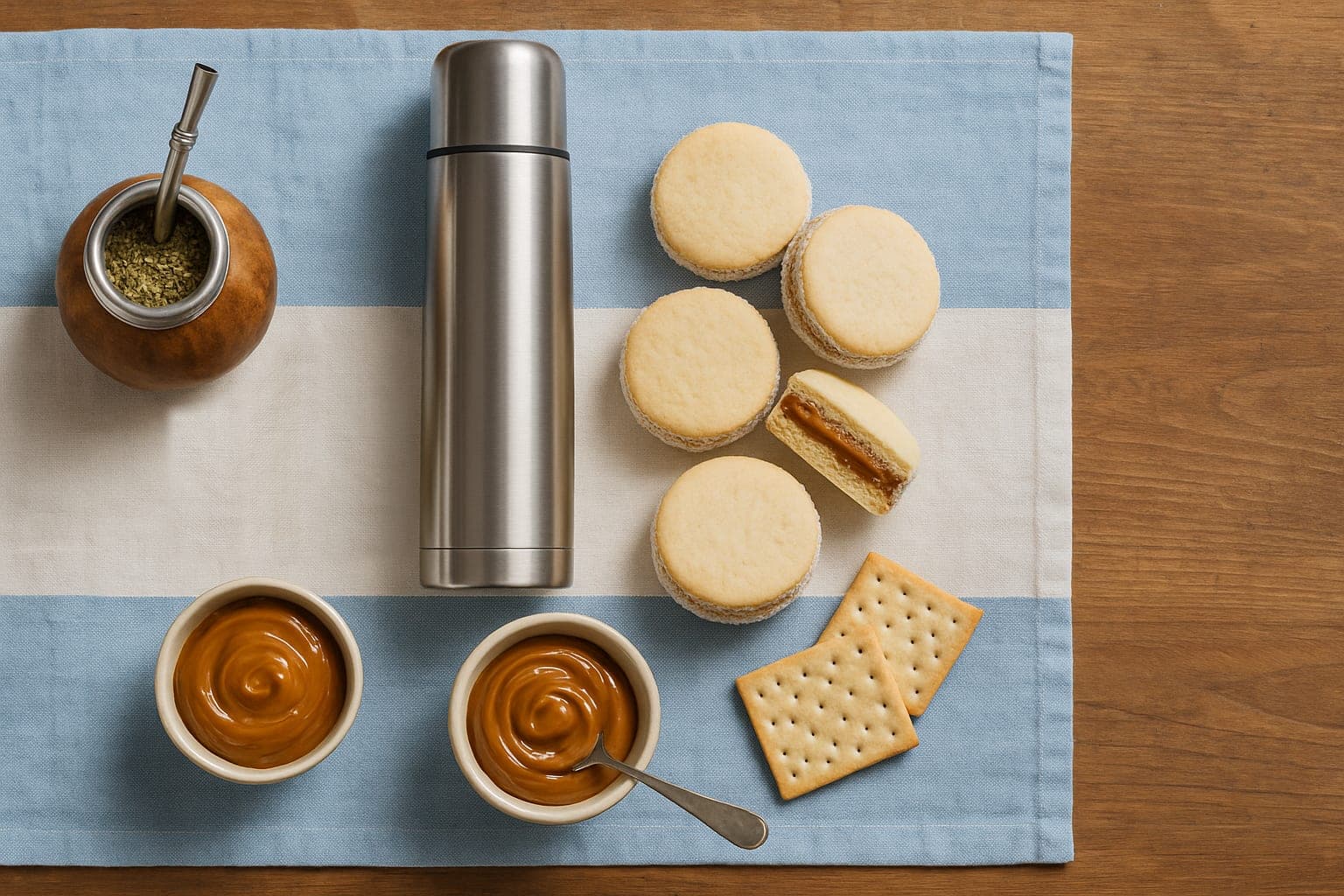
Both are on our counter in Amsterdam. Caramel goes into the Salted Caramel cookie, soft caramel with a pinch of sea salt, and dulce de leche fills the alfajores we make by hand, soft cornstarch cookies rolled in coconut. Order one of each and the difference explains itself. The whole menu is on our cookies page.
If you are not in Amsterdam, a box of 18 alfajores de maicena ships to the US, the UK and across Europe, and you can put Salted Caramel cookies in a cookie gift box of your own. To bake with it at home, we stock Mardel Clásico and Havanna in our Argentine shop, shipped across Europe and the UK.
Taste it warm in Amsterdam
Order fresh stroopwafels to your door, or learn to make your own at a Melly's workshop in the heart of the city.