Dulce de Leche Cheesecake: Baked, with a Thick Dulce de Leche Top
Dulce de leche in the filling and a thick layer on top, on a biscuit base. The baked recipe, a no-bake version and what to do when it cracks.
By Daniel MellicovskyBaker and owner, Melly's Cookiebar
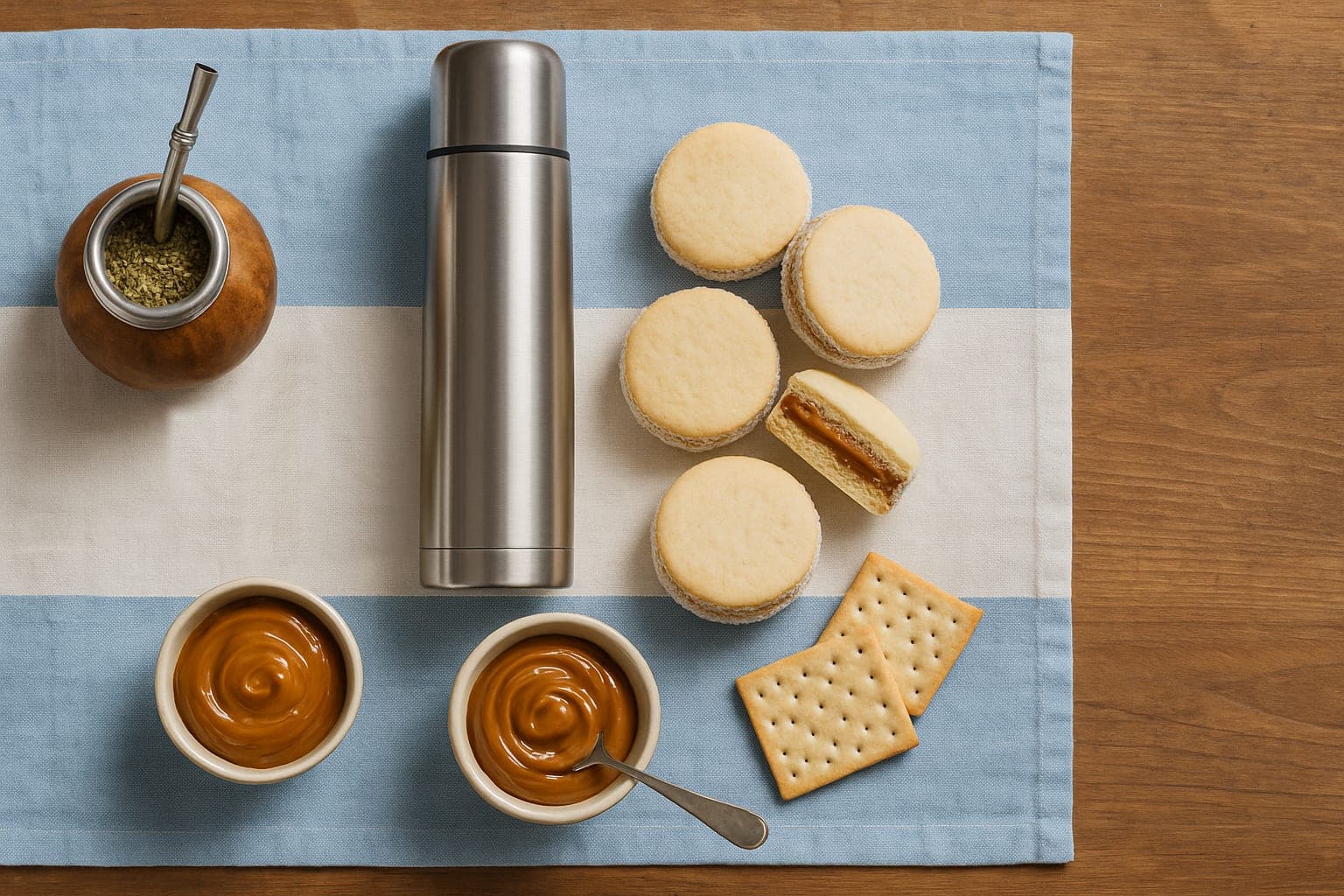
Walk into almost any café in Buenos Aires and there is a cheesecake in the counter with a thick, glossy layer of dulce de leche on top. It is one of the best things that ever happened to cream cheese: the tang of the filling takes the edge off the sweetness, and the dulce de leche gives the cake a caramel depth that a plain cheesecake never has. It sounds like too much sugar. It is not, as long as you keep the filling a little tart and add a pinch of salt.
This is the baked version, in the New York style, with dulce de leche in the filling and a proper layer on top. There is a no-bake version further down for when the oven is not an option. If you have never tasted dulce de leche, our guide to what dulce de leche is explains it. You can make it from milk and sugar or from a can of condensed milk, but this cake takes about half a kilo, and a jar is easier.
Ingredients
For the base (one 20 cm springform tin):
- 200 g digestive biscuits
- 90 g butter, melted
- A pinch of salt
For the filling:
- 600 g full-fat cream cheese, at room temperature
- 100 g caster sugar
- 250 g dulce de leche
- 150 g sour cream or crème fraîche
- 3 eggs, at room temperature
- 1 tablespoon cornflour
- 1 teaspoon vanilla extract
- Half a teaspoon of salt
For the top:
- 200 g dulce de leche
- 1 to 2 tablespoons warm cream or milk
- Flaky salt (optional)
Use the cream cheese that comes in a block or a tub of the full-fat kind, not the light, spreadable one, which has too much water and gives a filling that never quite sets. It has to be at room temperature, or you will get lumps. For the dulce de leche, the thick repostero type holds its shape best on top; the softer clásico is fine inside and works on top too if you chill the cake well first. A chocolate base, made with Chocolinas instead of digestives, is the Argentine way to do it.
Make the base
- Heat the oven to 180 °C (160 °C fan). Line the base of the tin with baking paper.
- Crush the biscuits to fine crumbs, in a food processor or in a bag with a rolling pin. Stir in the melted butter and the salt until the crumbs look like wet sand.
- Tip them into the tin and press them down firmly with the base of a glass, flat across the bottom and about 2 cm up the sides. Bake for 10 minutes and let it cool.
- If you are using a water bath, which we recommend, wrap the outside of the tin in two layers of foil so that no water can get in.
Make the filling
- Turn the oven down to 160 °C (140 °C fan).
- Beat the cream cheese and the sugar on low speed for a minute or two, scraping the bowl down, until completely smooth. Low speed is the rule for the whole filling: air beaten in now becomes cracks later.
- Add the dulce de leche, sour cream, cornflour, vanilla and salt and beat on low until there are no streaks left.
- Add the eggs one at a time, mixing each one in just until it disappears. Stop as soon as the last one is in.
- Pour the filling onto the base and tap the tin on the counter a few times to bring up any air bubbles.
Bake it
- Set the tin in a roasting tray and pour in boiling water until it comes halfway up the sides. The steam keeps the heat gentle and even, which is what stops the top from cracking.
- Bake for 60 to 70 minutes. It is done when the edges are set and the middle, a circle about the size of your palm, still wobbles like a set jelly when you nudge the tin. It will firm up as it cools.
- Turn the oven off, open the door a crack and leave the cheesecake in there for an hour. Sudden cold is the other thing that cracks it.
- Lift it out of the water, take off the foil and let it cool to room temperature. Then cover it and put it in the fridge for at least six hours. Overnight is better: the texture is denser and the flavour rounder the next day.
Finish it
Stir the dulce de leche for the top with a tablespoon of warm cream until it is smooth and spreads easily, adding a little more if it is very stiff. Run a thin knife around the edge of the cold cheesecake, release the springform, and spread the dulce de leche over the top with an offset spatula, right to the edge or stopping a centimetre short so the pale rim shows. A few flakes of salt on top make the whole thing taste more of caramel and less of sugar. Cut it with a long knife dipped in hot water and wiped between slices. It serves 10 to 12.
The no-bake version
This is closer to what most Argentine cafés actually serve: lighter, more like a mousse, and set in the fridge rather than the oven. Make the base as above, baked or simply chilled for half an hour. For the filling, beat 500 g of cream cheese with 300 g of dulce de leche, a teaspoon of vanilla and a pinch of salt until smooth. Whip 300 ml of cream to soft peaks and fold it in. If you want slices that stand up cleanly, dissolve 4 g of gelatine (two leaves) in two tablespoons of hot water and stir it into the cheese mixture before the cream goes in. Spread it over the base, chill for at least six hours and finish with the dulce de leche top exactly as above.
When it goes wrong
- It cracked. The filling was beaten on high, the cake was overbaked, or it cooled too fast. The good news is that the dulce de leche layer covers everything.
- The base is soggy. Water got in through the foil, or the base was not baked first. Two layers of foil, pressed tight, and the ten minutes in the oven fix both.
- The filling is lumpy. The cream cheese was cold. Leave it out for an hour next time. This time, press the filling through a sieve before it goes into the tin.
- The middle is still liquid after chilling. It came out too soon. The wobble should be in the centre only, not across the whole top, and it needs the full night in the fridge.
- The dulce de leche slides off. The cake was not cold enough, or the dulce de leche was thinned too much. Chill the cake hard and use a thick dulce de leche, loosened only as much as it needs to spread.
Storing it
Keep it covered in the fridge and eat it within four days. It freezes well without the top: wrap the cold cheesecake, freeze it for up to a month, thaw it overnight in the fridge and add the dulce de leche before serving.
Three ways to change it
- Swirled. Drop spoonfuls of dulce de leche onto the filling before it goes in the oven and drag a skewer through them. Then skip the top layer, or keep it; nobody has ever complained.
- With banana. A layer of sliced banana under the dulce de leche turns it into something close to a banoffee cheesecake.
- With coffee. A tablespoon of instant espresso dissolved in the vanilla cuts the sweetness and goes with dulce de leche the way it does in a chocotorta, which uses the same cream cheese and dulce de leche pairing with no oven at all.
Or let us do the baking
We do not make cheesecake at the Cookiebar, but if a dulce de leche cake for a birthday is what you are after, our bakery in Amsterdam makes a chocolate cake layered with dulce de leche custard, in a large size for 14 and a smaller one for 8 to 10. You can order it for today or any day in the next two months and pick it up at the shop; our birthday cakes page explains how. The classic layered version is in our dulce de leche cake recipe.
For the homemade cheesecake, we stock two Argentine jars, Mardel Clásico and Havanna, and the Chocolinas for the base. All of it ships across the Netherlands, Europe and the UK from our Argentine shop.
Taste it warm in Amsterdam
Order fresh stroopwafels to your door, or learn to make your own at a Melly's workshop in the heart of the city.